

Blog
Insurance Quote Follow-Up: A Simple Sequence That Stops Quotes Going Cold
Casia, Rosada Automation10 min read
The best insurance quote follow-up is fast and short. Acknowledge the request within minutes, make a real call the same day, then run 5 to 8 touches over about two weeks across call, text, and email, and finish with a clear close-the-file message. The sequence stops the moment the prospect replies, binds, or opts out; automation runs the clock, and your licensed producers still do the quoting and the advice.
Want to see where quotes stall in your agency first? Get the free workflow map. Free, no call.
Below: the schedule, the rules, the messages, and how the workflow is built.
Why quotes go cold
Most lost quotes aren't lost on price.
They're lost in the gap between the quote going out and the next touch.
A prospect who fills out a quote form usually fills out more than one. The agency that responds first and keeps following up gets the conversation. The agency that sends one email and waits for a reply usually gets silence.
The best-known research on this is the 2011 Harvard Business Review study "The Short Life of Online Sales Leads." The authors audited 2,241 US companies with a test web lead:
- 37% responded within an hour.
- 24% took more than 24 hours.
- 23% never responded at all.
- The average response time, among companies that answered within 30 days, was 42 hours.
In a separate set of 1.25 million leads, firms that tried to contact a lead within an hour were nearly 7 times as likely to have a meaningful conversation with a decision maker as firms that waited even an hour longer.
Two honest caveats. One co-author ran the sales software company whose data was used, and HBR is a magazine, not a peer-reviewed journal. And the "5 minutes vs 30 minutes, 21x" figure you see in vendor decks doesn't come from that HBR article. The direction is still clear: the first hour matters, and a quarter of businesses don't respond at all.
For an independent agency, that's good news. The bar is low.
What a good quote follow-up sequence looks like
Here's a starting schedule for personal lines quotes. Adjust spacing to your book, your state's calling hours, and what the prospect tells you.
| When | Channel | Purpose | Who |
|---|---|---|---|
| Minute 0-5 | Text (if consented) + email | "Got your request. Here's what happens next and when." | Automated |
| Within 1 hour | Call | Confirm details, answer questions, quote or set a time | Producer |
| Same day | Quote in writing, plain-language summary, one next step | Automated, producer's name | |
| Day 1 | Call at a different time | Questions, coverage comparison | Producer |
| Day 3 | Text | One useful question: "Want me to compare a higher deductible?" | Automated |
| Day 5-7 | Call + short email | Address the likely objection: price, coverage, timing | Producer |
| Day 10 | Light check-in, offer to re-quote at their X-date if timing is the issue | Automated | |
| Day 14 | Text or email | Close the file: "Should I keep this open or close it out?" | Automated |
That's 8 touches in 14 days. Fewer than that and most quotes never get a second real touch. More than one a day and you're noise.
Stop rules matter more than the schedule
A sequence without stop rules is how agencies annoy good prospects. Every automated step should check, before it sends:
- Did they reply? Pause everything and alert the producer.
- Did they bind? Stop sales messages. Start onboarding instead.
- Did they say no or opt out? Stop on every channel. Record the reason.
- Was the quote revised? Cancel messages that reference the old numbers.
- Did they give a later date? Park the file until then. That's an X-date, not a lost lead.
Commercial lines run slower
Small commercial buyers take longer and often involve more than one decision maker. Stretch the same structure to 30 days with wider gaps. Speed still matters for the first touch. It matters less for touch six.
The rules that keep it clean
This isn't legal advice. It's the short list every agency should check with its own counsel and E&O carrier.
- Get text consent on the quote form itself. A phone number on a form isn't, by itself, permission to send automated texts. Use a clear, separate checkbox that says you may call or text about this request.
- Name yourself in every first message. Agency name and producer name.
- Make STOP work. Twilio's messaging policy requires opt-out language like "Reply STOP to unsubscribe" in the first message and says nothing more goes out after an opt-out, except one confirmation.
- Keep consent to the subject they agreed to. Consent to hear about their auto quote isn't consent to a newsletter.
- Keep a record. What they agreed to, when, and on which form.
The FCC's consumer guide is a good plain-English starting point: commercial texts require written consent, and people can opt out "in any reasonable manner." That includes a prospect saying "stop calling" on a live call. Your system needs a way to record that too, not just the word STOP.
Example workflow: how it's built

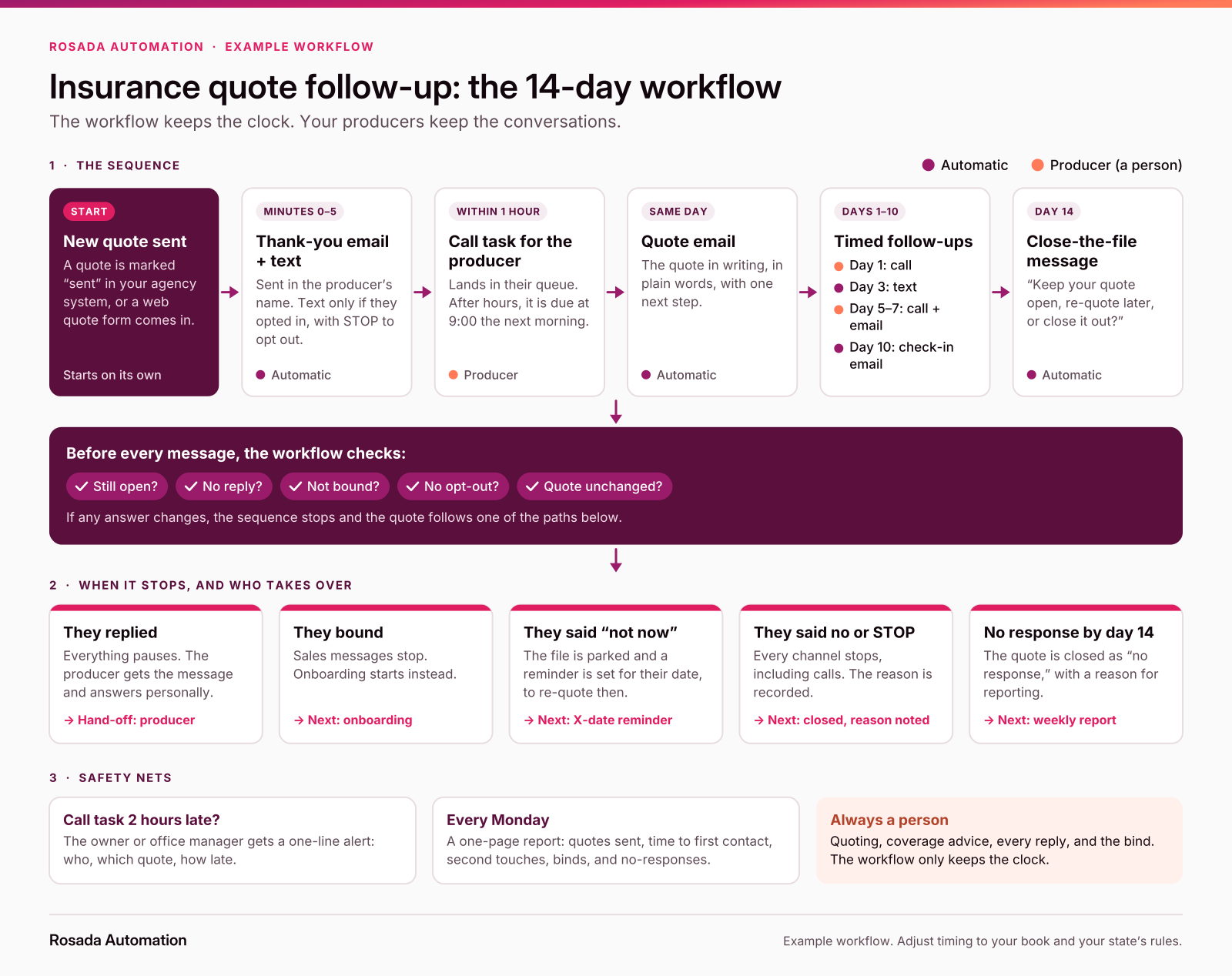
The example workflow at a glance: what runs on its own, what goes to a producer, and when it stops.
Want this mapped for your agency? The free workflow map shows how your quotes get followed up today and where they leak. Free. No email signup or call required.
Here's how a quote follow-up workflow comes together in n8n for a small independent agency. The tools are examples. The structure works with whatever AMS, rater, and phone system you already use.
1. Trigger: a quote is marked "sent." The workflow starts when a quote status changes in your AMS or CRM, or when your website quote form is submitted. No one has to remember to start it.
2. Acknowledge within minutes. An email goes out from the producer's name, not a generic inbox. If the prospect checked the text box, a short text goes too, with the agency name and STOP language.
3. Create the producer's call task. The task lands in the producer's queue with the prospect's name, the line of business, and a due time of one hour. If it's after hours, it's due at 9:00 the next morning, and the acknowledgment says so honestly.
4. Wait, then check before each step. n8n's Wait node pauses the workflow for a set time, or until a specific date, or until a webhook call resumes it. Before every send, the workflow re-checks the AMS: still open, no reply, no bind, no opt-out. If any check fails, that branch stops.
5. Route replies to a person. Any reply, text or email, pauses the sequence and pings the producer with the message attached. Automation never answers coverage questions.
6. Escalate overdue tasks. If a producer's call task is two hours overdue, the agency owner or office manager gets a short alert. One line: who, which quote, how late.
7. Close the file on day 14. The last message asks a yes/no question. A reply of "not now" sets an X-date reminder. Silence marks the quote "no response," with a reason code for reporting.
8. Report weekly. A one-page summary lands in the owner's inbox every Monday: quotes sent, median time to first contact, quotes with a second touch, binds, and quotes closed with no response.
What stays human: quoting, coverage advice, any reply, and the bind. The workflow handles the clock and the reminders.
Message examples you can adapt
Short, specific, and from a person.
Acknowledgment text (minute 0-5): "Hi Dana, this is Mike at Northside Insurance. Got your auto quote request. I'll call you by 3:30 today. Reply STOP to opt out."
Same-day email subject: "Your auto quote: 2 options" "Dana, here are two options from two carriers. The difference is the deductible. Reply with any question, or pick a time and I'll walk you through it. Mike"
Day 3 text: "Dana, one question on your quote. Would it help to see the price with a $1,000 deductible? Mike, Northside Insurance."
Day 14 close-the-file email subject: "Keep your quote open?" "Dana, I don't want to keep emailing if the timing's off. Should I keep this quote open, re-quote closer to your renewal date, or close it out? One word is fine. Mike"
Note what's missing: "just checking in," exclamation points, and fake urgency.
What to measure
Four numbers. Pull them weekly, not monthly.
- Median time to first contact. From request to first real contact attempt. An auto-text doesn't count.
- Quotes with a second touch. If this is under 100%, that's the first fix.
- Quote-to-bind rate. Bound policies divided by quotes delivered. Track auto, home, and commercial separately.
- Quotes closed with no response. Watch this shrink.
Read these from your own book. Your carrier mix, market, and lead sources will move them more than any benchmark.
When you don't need this
If your agency sends a handful of quotes a week and one person sees every one, a shared calendar and a daily list may be enough. Write the schedule down and use it.
The workflow earns its keep when quotes come from several places (website, referrals, carrier portals, purchased leads), when producers are out with clients, or when follow-up depends on whoever remembers.
Start with a map
Before you buy software or build anything, map where a quote request actually goes in your agency today. Where it arrives, who sees it, how long until a call, and where it stalls.
FAQ
How fast should I follow up on an insurance quote request?
Within the first hour, and faster on weekdays during business hours. The HBR study found that firms contacting a web lead within an hour were nearly 7 times as likely to reach a decision maker as firms that waited an hour longer. An automated acknowledgment can go out in minutes; the first real call should follow within the hour.
How many times should I follow up on an insurance quote before giving up?
Plan for 5 to 8 touches over about 14 days, mixing calls, texts (with consent), and email. End with a close-the-file message that asks whether to keep the quote open, re-quote later, or close it. Stop right away on a reply, a bind, a "no," or an opt-out.
Can I text an insurance prospect who filled out a quote form?
Only with the right consent. A phone number on a form isn't, by itself, consent to automated texts. Add a clear checkbox to your quote form, identify your agency in every first text, and honor STOP immediately. Check the details with your counsel or E&O carrier.
What should an insurance quote follow-up email say?
One quote summary in plain language, one useful point (for example, how a deductible change moves the price), and one next step. Send it from the producer's name. Skip "just checking in."
Can I automate insurance quote follow-up without losing the personal touch?
Yes. Automate the clock: acknowledgments, reminders, call tasks, stop checks, and reporting. Keep people on quoting, coverage questions, replies, and binding. Messages should come from a named producer and read like a person wrote them.
Does the same sequence work for renewals?
The structure carries over, but the timing doesn't. Renewal outreach usually starts 60 to 90 days out, with a coverage review before the price conversation. That's a separate workflow, and it's often where cross-sell conversations happen.
Sources
- Oldroyd, McElheran, and Elkington, "The Short Life of Online Sales Leads," Harvard Business Review, March 2011: https://hbr.org/2011/03/the-short-life-of-online-sales-leads (full-text figures verified from the article PDF: https://thedenmangroupselling.wordpress.com/wp-content/uploads/2011/03/the-short-life-of-online-sales-leads-harvard-business-review.pdf)
- SEOD, "Lead response time and what the research really shows" (sourcing caveats on the HBR and 21x figures), September 2026: https://seod.com/blog/lead-response-time-research-really-shows/
- Lead Friendly, "Insurance Lead Follow-Up Cadence: How Often to Call," October 2026: https://www.leadfriendly.com/guides/insurance-agency-lead-follow-up-cadence
- Twilio Messaging Policy, updated April 13, 2026: https://www.twilio.com/en-us/legal/messaging-policy
- FCC, "Stop Unwanted Robocalls and Texts," reviewed February 27, 2026: https://www.fcc.gov/consumers/guides/stop-unwanted-robocalls-and-texts
- n8n Docs, Wait node: https://docs.n8n.io/integrations/builtin/core-nodes/n8n-nodes-base.wait/
Casia