

Blog
Insurance Agency Renewal Process: 5 Checkpoints So No Renewal Slips
Casia, Rosada Automation10 min read
A good renewal process gives every policy the same five checkpoints, each with a named owner: list renewals well before the X-date, contact the client, run a coverage review, decide whether to renew or remarket, then verify the issued policy and close the file. Plain automation rules can open the tasks, send reminders and stop when someone replies. A licensed producer makes the coverage calls, and every review and declined coverage gets written down.
Not sure where renewals slip in your agency? Get your free workflow map. About 2 minutes. Free, no call.
(This is about policy renewals, not renewing your agent license.)
Why do renewals slip in small agencies?
An untouched renewal doesn't announce itself. The first sign is often a call about a price jump, or a coverage the client assumed they had.
That second one matters most. An E&O claims specialist writing in IA Magazine puts the most common E&O claim in the client's own words: "You failed to get me the coverage I wanted or enough of the coverage I wanted." In the same piece, a recent renewal document the client had signed, listing the limits of all their buildings, "quickly put the claim to bed."
So a renewal process means touching every file on purpose, and leaving a record that you did.
What are the five checkpoints, and who owns each one?
The timings are examples; pick your own based on carrier lead times and account complexity. They're not legal deadlines. Notice rules vary by state and generally fall on the carrier.
| Checkpoint | Example timing (pick your own) | Owner | What runs automatically | What a person does |
|---|---|---|---|---|
| 1. List and triage | ~120 days before the X-date for commercial and complex accounts; ~90 for personal lines | Account manager | A weekly renewal list from the AMS, sorted by X-date, with flags for claims, big premium changes and nonrenewal notices | Marks each account routine, review or at risk |
| 2. Contact the client | ~90 days | Account manager | A review-invite email (and a text, only with consent) plus one reminder; stops on reply | Takes the call or the reply |
| 3. Coverage review | ~60-90 days | Licensed producer | A prep record: last year's notes, policies on file, coverages declined last year | Reviews exposures and coverages, recommends, documents |
| 4. Renew or remarket | ~45-60 days | Producer + account manager | Opens a remarket task if the account matches the agency's own remarket rule | Decides, quotes, presents options |
| 5. Verify and close | X-date and the weeks after | Account manager | A task to compare the issued policy with the expiring one; a "renewed" confirmation to the client | Checks forms and limits, files the confirmation |
For comparison, one AMS vendor's blog shows a "60 days out: Policy review" email and a "30 days out: Final nudge." One example, not a standard.
Checkpoint 1: List and triage
A weekly rule pulls upcoming renewals into one list. The account manager sorts it; anything at risk (a claim, a big change, a nonrenewal notice) goes to a producer early.
Checkpoint 2: Contact the client
A short email asks what changed. One reminder, then a call task. When the client replies, the automation stops and a person takes over.
Checkpoint 3: The coverage review
#### What does the review cover, and what do you write down?
- What changed: drivers, vehicles, address, renovations, staff or revenue.
- Limits and deductibles against the expiring policy.
- Endorsements, and mortgagee or lienholder details.
- Coverages declined last year, offered again.
- A single-policy or no-umbrella flag, so the producer can ask about the rest of the client's coverage.
How often should you re-offer declined coverage? IA Magazine put that question to its experts, and there's no single rule. Answers range from "once is enough" if you documented the offer, to "every year or two at the most," to a sign-off at every renewal review when the coverage is significant. Two points stood out: ask your E&O carrier and your attorney, and stay consistent. So pick a rule, write it down, and follow it every time.
Then document it: a written summary after the review, the client's confirmation of anything declined, and notes in your AMS. The IA Magazine claims piece backs all three (sign-offs, notes "preferably in a management system," and email follow-ups that confirm a call). Good records can help if a claim ever comes up.
The single-policy flag isn't a sales push; IA Magazine calls account rounding "a consultative risk-reduction approach" and notes that the service team may be in the best position to spot the openings.
If you want AI to draft the prep note or the summary, here's how we split AI, rule and producer work.
Checkpoint 4: Renew or remarket
#### What's a remarket rule you set once?
Write a trigger list once: a carrier nonrenewal, a premium change above a threshold you choose, a new restriction or exclusion, a claims surcharge, or the client asks. A match opens a remarket task.
From here it's a quote, so treat it like one; our insurance quote follow-up sequence covers the follow-up.
Checkpoint 5: Verify and close
At the X-date, the account manager compares the issued policy with the expiring one (forms, limits, deductibles, named insureds), sends a short "renewed" note, and closes the file.
What does the workflow look like on one page?

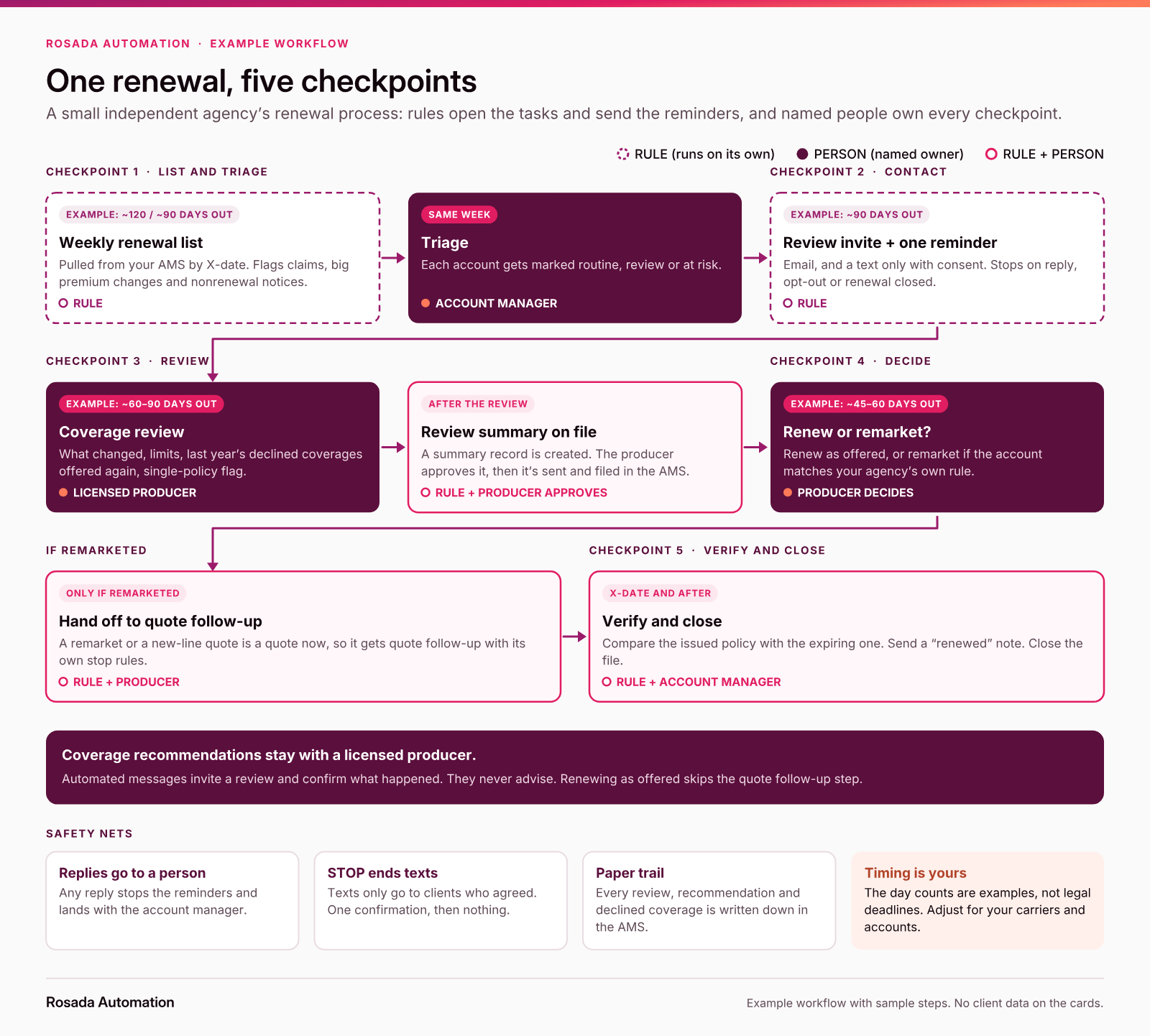
One renewal, five checkpoints: rules open tasks and send reminders; named people own every step.
Most of it is plain rules: dates, tasks, reminders, stop checks. The one pause that matters is the summary: nothing goes to the client until the producer approves it. You can see that "wait for a person's OK" pattern in our approvals with a human check example run (sample data, shown on a refund example).
What messages can you adapt?
Short, plain, from a person. Names are made up.
1. Review invite email. Subject: "Your auto policy renews in June: a quick review" "Hi Dana, your auto policy renews in June. Has anything changed this year? New drivers, a new car, a move? I'm free Tuesday at 10, Wednesday at 2 or Thursday at 4, or just reply. No changes is a fine answer. Mike, Northside Insurance"
2. Review invite text (only with consent): "Hi Dana, it's Mike at Northside Insurance. Your auto policy renews in June. Any changes this year? Reply here or call. Reply STOP to opt out."
3. Review summary email (after the call): "What we reviewed / What I recommend / What you chose / Coverage you decided not to add this year. Please reply 'confirmed' so I can note it in your file."
4. Declined-coverage re-offer line (next year): "Last year you decided not to add [coverage]. I'm offering it again. Here's the price if you'd like it."
5. Remarket heads-up: "Your carrier's renewal came in with [change]. I'm shopping it and will have options by [date]."
6. Renewed confirmation: "Your policy renewed on [date]. The documents are attached. Reply if anything looks different from what we discussed."
What are the texting and email rules for renewal reminders?
Not legal advice; check with your counsel.
- Consent first. The TCPA restricts autodialed calls and texts without prior express consent (written consent for marketing), as in our quote follow-up post.
- Opt-outs count however they arrive. Under FCC 24-24, people can revoke consent by any reasonable means. Send one confirmation text, then stop.
- Every text names the agency and includes STOP.
- The 2023 "one-to-one" consent rule isn't in effect. The 11th Circuit vacated it in Insurance Marketing Coalition v. FCC (January 24, 2025), and the FCC removed it from its rules effective August 29, 2025.
- Messages invite; producers advise. The NAIC Producer Licensing Model Act (#218), a model for state laws, says a person can't "sell, solicit or negotiate" insurance without a license for that line. Automations schedule, remind and record; they don't recommend coverage.
What should you measure?
Five counts from your AMS:
- Renewals worked before the X-date vs. never touched
- Coverage reviews completed
- Declined coverages re-offered and documented
- Remarkets opened, and how many you kept
- Renewals lost, with the reason
Compare against your last quarter, not a benchmark.
Start with a map
Want to see a run? Try the quote follow-up example (sample data).
FAQ
What is the renewal process at an insurance agency?
It's the set of steps an agency runs on every policy before and after its expiration date. A simple version has five checkpoints, each with an owner: list and triage, contact the client, coverage review, the renew-or-remarket decision, and verify-and-close. The carrier issues the renewal, but the agency reviews it with the client and keeps a record.
How far before the expiration date should an agency start a renewal?
Early enough to remarket if you need to. One example calendar: about 120 days out for commercial and complex accounts, and about 90 days out for personal lines. Adjust for your carriers' lead times and the size of the account. It's a starting point you choose, not a legal deadline.
What should a renewal review include?
What changed in the past year, limits and deductibles against the expiring policy, endorsements, mortgagees and lienholders, coverages the client declined last year, and gaps such as no umbrella. Finish with a written summary of what you reviewed, what you recommended and what the client chose, and save it in your AMS.
Should I re-offer coverage a client declined last year?
IA Magazine's expert Q&A gives a range of answers: once may be enough if it's documented, every year or two at the most, or a sign-off at each renewal review for significant coverage. The basics hold either way. Set a rule with your E&O carrier and attorney, document every re-offer and every decline, and follow the same rule every time.
When should a renewal be remarketed?
When it matches a trigger list your agency sets ahead of time: a carrier nonrenewal, a premium change above your own threshold, a new restriction or exclusion, a claims surcharge, or the client asks. Once you remarket, treat it as a new quote with its own follow-up, so it doesn't stall before the X-date.
Can we send renewal reminders by text?
Yes, with the client's prior consent, the agency named in the message, and a working STOP. Under the FCC's 2024 revocation order, clients can opt out by any reasonable means, so honor every opt-out. Messages invite a review; only a licensed producer recommends coverage. This is not legal advice.
Sources
- IA Magazine, "Why Documentation Will Make Sure You Never Speak to an E&O Claims Handler" (March 28, 2024): https://www.iamagazine.com/2024/03/28/why-documentation-will-make-sure-you-never-speak-to-an-eo-claims-handler/
- IA Magazine, "How Often Should an Agent Reoffer Declined Coverage?" (July 1, 2022): https://www.iamagazine.com/2022/07/01/how-often-should-an-agent-reoffer-declined-coverage/
- IA Magazine, "Rounding Up: Overcoming the Service Team's Objections About Account Rounding" (January 7, 2026): https://www.iamagazine.com/2026/01/07/rounding-up-overcoming-the-service-teams-objections-about-account-rounding/
- HawkSoft blog (vendor; guest post), "4 Ways to Use Your AMS Data to Automate Client Retention": https://blog.hawksoft.com/4-ways-to-use-your-ams-data-to-automate-client-retention
- NAIC, Producer Licensing Model Act (#218), Section 3: https://content.naic.org/sites/default/files/model-law-218.pdf
- FCC, Report and Order, FCC 24-24 (adopted February 15, 2024): https://docs.fcc.gov/public/attachments/FCC-24-24A1.pdf
- U.S. Court of Appeals for the Eleventh Circuit, Insurance Marketing Coalition Ltd. v. FCC, No. 24-10277 (January 24, 2025): https://media.ca11.uscourts.gov/opinions/pub/files/202410277.pdf
- Federal Register, FCC final rule removing the vacated consent paragraph, doc. 2025-16641 (effective August 29, 2025): https://www.federalregister.gov/documents/2025/08/29/2025-16641/delete-delete-delete-targeting-and-eliminating-unlawful-text-messages-rules-and-regulations
Casia