

Blog
AI for Insurance Agents: What to Hand Off, What to Keep
Casia, Rosada Automation10 min read
AI helps a small independent agency most with language work: drafting quote follow-ups and renewal emails, summarizing calls and notes into your AMS, and sorting intake. Reminders, task routing, and stop rules don't need AI; plain automation rules do them more reliably. Coverage advice, recommendations, binding, and anything that creates E&O exposure stay with a licensed producer, who reviews every AI draft before it goes out.
Want to see which of your agency's tasks are AI jobs and which are rule jobs? Get your free workflow map. About 2 minutes. Free, no call.
AI, a rule, or a person? What's the one-question test?
Ask what the step really needs:
- Words written or read? AI drafts it, a person checks it.
- A yes/no decision from data? That's a rule. "Client replied" needs no AI.
- Professional judgment about coverage? That's a licensed producer, every time.
Treat AI as a fast first draft that can be wrong. IA Magazine says to check AI output against the policy forms before anything reaches a client.
Where does AI actually help a small agency?
Five everyday jobs, split three ways:
| Task | AI's job | Rule's job (no AI) | Person's job |
|---|---|---|---|
| Quote follow-up | Draft the email or text in the producer's voice | Timing; stop on reply, bind, or opt-out | Producer approves wording, answers coverage questions |
| Call and meeting notes | Summarize the call into AMS fields and a to-do list | File it to the right client record | Producer checks it before it's saved |
| Renewal outreach | Draft a review email that mentions what the client said last year | Open the task a set number of days before the X-date; remind if no reply | Producer decides whether to remarket, and what to recommend |
| New inquiry | Sort a form or email by line, new vs existing, urgency | Instant acknowledgment; assign a producer | Producer makes first contact, gathers underwriting info |
| Certificates, ID cards, service | Draft the reply | Route to the CSR queue | CSR issues documents per carrier rules |
Quote follow-up. The schedule (touches, timing, stop rules) is in our insurance quote follow-up sequence. AI's only job there is the first draft.
Call notes. The safest place to start: nothing reaches a client or the AMS until a person approves it. See the call notes to CRM example run (sample data).
Reminders, tasks, and report counts: no AI needed. If a rule can decide it, don't pay an AI to guess.
Prompts and messages you can borrow
Drafts for a producer to review, not auto-send messages.
Renewal prep note (prompt): Summarize these notes from [client]'s last renewal and any service calls since. List: changes they mentioned, open questions, and anything to confirm. Don't recommend coverage. Under 120 words.
Renewal email draft (prompt): Draft a short email from [producer] to [first name] asking for 15 minutes to review their renewal before [month]. Mention [one thing they told us last year]. No coverage advice, no prices. Plain, friendly, under 90 words.
Renewal text (only if the client opted in to texts): [Agency]: Hi [First name], it's [Producer]. Your renewal is coming up. Got 15 min this week to review it? Reply here or call [number]. STOP to opt out.
What stays human?
- Coverage advice, recommendations, and explaining what a policy covers
- Binding, and changing limits or deductibles
- Claims coverage opinions
- Declining or non-renewing, and anything tied to a complaint
Why: licensing (below) and E&O. IA Magazine suggests a written AI policy that bars binding, changing limits, or coverage advice without human review, and keeping a record of what AI drafted and what the producer changed. Check your E&O policy for AI exclusions, too.
A one-line policy for your team:
"AI writes first drafts. A licensed producer approves anything about coverage, price, or binding. Client data only goes into tools the agency has approved."
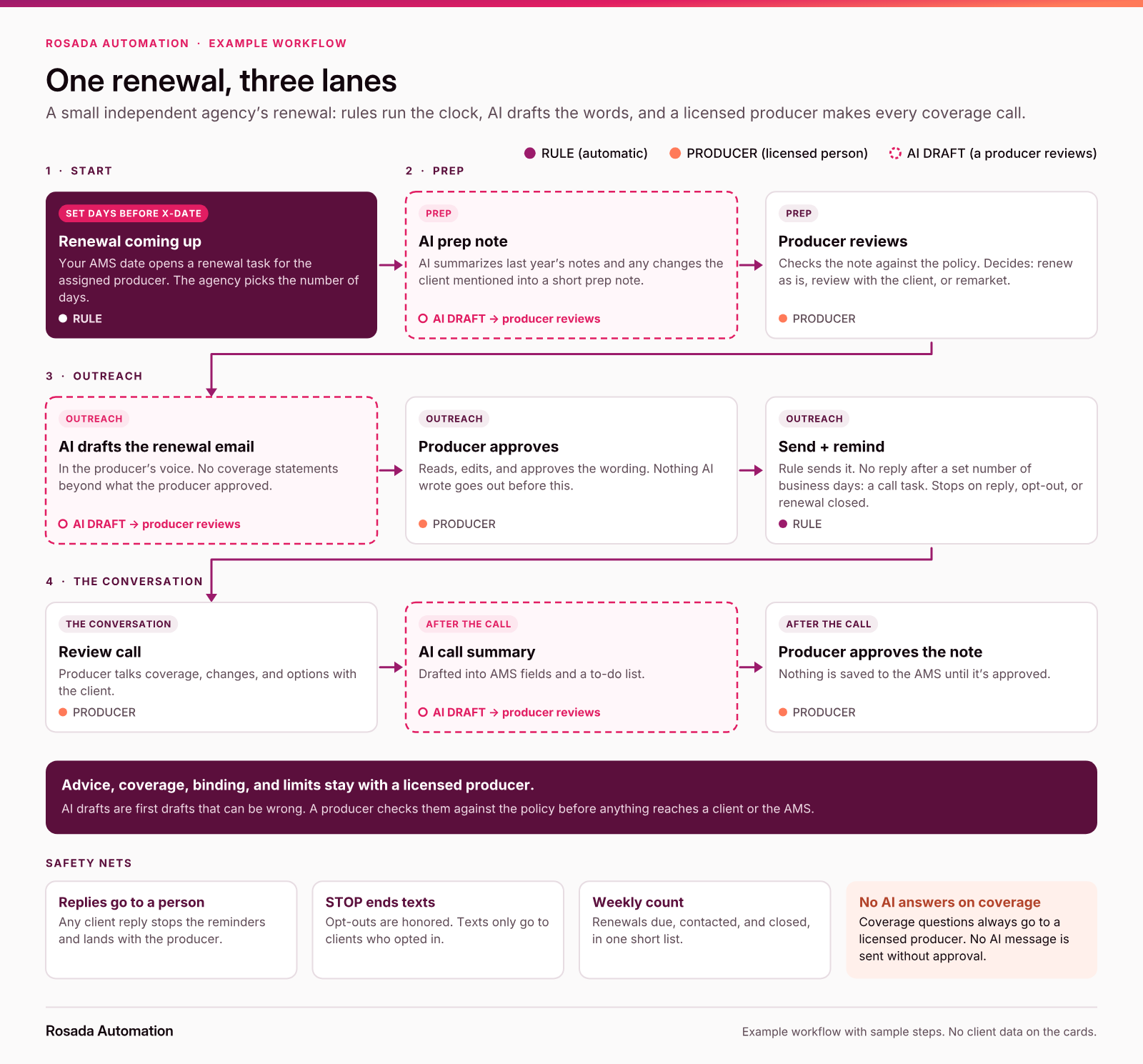
The workflow: one renewal, three lanes
Every AI step sits between a rule and a person.

How can AI help you cross-sell at renewal without pushing?
Let a rule find single-policy clients before each renewal, let AI draft a short review note, and let a licensed producer decide whether anything else fits. IA Magazine calls account rounding "a consultative risk-reduction approach," not an aggressive sell.
- Rule: ahead of the X-date, flag single-policy clients, or home-and-auto clients with no umbrella. Check your AMS first; HawkSoft, for one, documents a report like this.
- AI draft: a prep note (what's written elsewhere, what changed) and a short note in the producer's voice asking whether they'd like their other coverage reviewed. No product named, no savings promised.
- Producer: reviews, approves, and holds the conversation. Any coverage suggestion, quote, or comparison comes from the producer, if the carrier writes it. Unlicensed service staff can spot openings and pass them along.
- Rule: sends, reminds once, and stops on a reply, opt-out, "not interested," or the renewal closing. It logs the outcome.
Same three lanes: AI drafts, rules decide, the licensed producer advises. Consent and opt-out rules for texts and email apply no matter who wrote the message.
Want to see where renewals and single-policy clients slip in your agency? The free workflow map shows it on one page. About 2 minutes. Free, no call.
What are the best AI tools for insurance agents?
Pick by job, not by brand:
- A business-tier AI assistant your agency approves, for drafting and summarizing.
- The AI or automation features already in your AMS or CRM. Check these first.
- A workflow tool that connects your web form, AMS, email, and texting with rules.
- Call recording and transcription, only with consent handled.
Before you buy, ask what it does with client data and who checks its output. If you'd rather have someone build it, here are the questions to ask before you hire anyone.
What compliance basics apply before you turn anything on?
This is general information, not legal advice. Check with your counsel.
Licensing and advice
State licensing laws, most based on the NAIC Producer Licensing Model Act (#218), say a person shall not "sell, solicit or negotiate insurance" without a license for that line. "Negotiate" includes "offering advice directly to a purchaser or prospective purchaser" about a contract's "substantive benefits, terms or conditions." NAIC implementation guidelines treat interpreting coverage and recommending coverage as licensed activity. Keep advice with a licensed producer.
Texting and the TCPA
Who wrote the message doesn't change the rules. The FCC's consumer guide says commercial texts need written consent. Under FCC 24-24, the 2024 consent revocation order, people can opt out by any reasonable means, and replies like "stop," "cancel," or "unsubscribe" count. Send one confirmation, then nothing. The FCC's 2023 "one-to-one consent" rule isn't in effect: the Eleventh Circuit vacated it in January 2025 (Insurance Marketing Coalition v. FCC), and the FCC removed it in August 2025.
The NAIC AI model bulletin
The NAIC Model Bulletin: Use of Artificial Intelligence Systems by Insurers (adopted December 4, 2023) is addressed to insurers, not agencies. It covers AI in sales and distribution and AI from third parties, so carriers may pass expectations down. A growing number of states have adopted it; check the NAIC's adoption map for yours.
Client data and carrier contracts
Big I and ACT's AI guidance, summarized in KIA&B's magazine, says don't upload confidential information to AI platforms, and watch for carrier contract limits on AI. IA Magazine adds: keep loss runs out of unapproved public AI tools.
When don't you need AI?
A few quotes a week, notes logged the same day, and renewals on a list someone works? A reminder rule and a template may be all you need.
Start with a map
See a quote follow-up example run (sample data). This is the kind of thing I build, in your tools.
FAQ
How can insurance agents use AI?
Mostly for language work. AI can draft quote follow-ups and renewal emails, summarize calls into your AMS, and sort new inquiries by line and urgency. Reminders and task routing work better as plain automation rules. A licensed producer should review every draft and keep all coverage advice, recommendations, and binding decisions.
What are the best AI tools for independent insurance agents?
It depends on the job, not the brand. Most small agencies need an approved business-tier AI assistant, the automation already in their AMS or CRM, and a workflow tool that connects forms, email, and texting with rules. Before buying, check what each tool does with client data.
Will AI replace insurance agents?
Not the parts clients rely on an agent for. AI can draft, summarize, and sort, but coverage advice, recommendations, and placing coverage are licensed activities, and E&O exposure stays with the agency. What AI can replace is a lot of typing and chasing, which frees producers for client conversations.
Can AI give insurance advice to my clients?
It shouldn't. State licensing laws based on the NAIC Producer Licensing Model Act require a license to sell, solicit, or negotiate insurance, and negotiating includes advising on a policy's terms. Treat AI output as a draft, have a licensed producer approve anything about coverage, and route client coverage questions to a person. This is general information, not legal advice.
What is account rounding in insurance?
Account rounding means writing the rest of a client's insurance at the same agency, based on a needs review. That might be another line, an umbrella, or business and personal coverage together. It's a service conversation, not a hard sell: a licensed producer reviews what the client has and recommends added coverage only where it fits, if the carrier writes it.
How can AI help an insurance agency cross-sell at renewal?
AI can draft the outreach, but only a licensed producer recommends coverage. A rule flags single-policy clients a set number of days before renewal. AI drafts a prep note and a short invitation to review their other coverage. The producer decides whether any added coverage fits, if the carrier writes it, and makes any recommendation. No savings promises, and a rule stops on reply or opt-out.
Sources
- NAIC, "NAIC Model Bulletin: Use of Artificial Intelligence Systems by Insurers" (adopted December 4, 2023): https://content.naic.org/sites/default/files/inline-files/2023-12-4%20Model%20Bulletin_Adopted_0.pdf
- NAIC, "Implementation of NAIC Model Bulletin: Use of Artificial Intelligence Systems by Insurers" (adoption map, status as of October 8, 2026): https://content.naic.org/sites/default/files/legal-adoption-map-ai-model-bulletin.pdf
- NAIC, "Producer Licensing Model Act" (Model #218): https://content.naic.org/sites/default/files/model-law-218.pdf
- NAIC, "Implementation Guidelines of the Producer Licensing Model Act" (licensable and non-licensable activities, August 27, 2000): https://content.naic.org/sites/default/files/inline-files/committees_ex_pltf_plwg_Licensable_Activities.pdf
- IA Magazine, "5 Ways Insurance Agencies Can Reduce AI-Driven E&O Exposures," Timothy Ventura and Dana A. Gittleman (September 9, 2026): https://www.iamagazine.com/2026/09/09/5-ways-insurance-agencies-can-reduce-ai-driven-eo-exposures/
- KIA&B magazine, Mar/Apr 2025, "Big I and ACT Provide Memo, Sample Policy on AI," Scott Kneeland, IIABA: https://viewer.joomag.com/kiab-marapr2025-digital-1/0355539001744646175/p30
- FCC, "Stop Unwanted Robocalls and Texts" (consumer guide): https://www.fcc.gov/consumers/guides/stop-unwanted-robocalls-and-texts
- FCC, Report and Order and Further Notice of Proposed Rulemaking on revoking consent, FCC 24-24 (adopted February 15, 2024): https://docs.fcc.gov/public/attachments/FCC-24-24A1.pdf
- U.S. Court of Appeals for the Eleventh Circuit, Insurance Marketing Coalition Ltd. v. FCC, No. 24-10277 (January 24, 2025): https://media.ca11.uscourts.gov/opinions/pub/files/202410277.pdf
- Federal Register, FCC rule conforming to the court decision, 2025-16641 (August 29, 2025): https://www.federalregister.gov/documents/2025/08/29/2025-16641/delete-delete-delete-targeting-and-eliminating-unlawful-text-messages-rules-and-regulations
- IA Magazine, "Rounding Up: Overcoming the Service Team's Objections About Account Rounding," Jessica Orange and Bonnie Weise (January 7, 2026): https://www.iamagazine.com/2026/01/07/rounding-up-overcoming-the-service-teams-objections-about-account-rounding/
- HawkSoft blog, "Getting Started with HawkSoft's Agency Intelligence and Sales & Retention Reports" (an AMS vendor describing its own reports; cited as an example): https://blog.hawksoft.com/agency-intelligence-sales-retention
- Rosada Automation, "Call notes to CRM" (example run with sample data): https://rosadaautomation.com/automations/call-notes-to-crm
- Rosada Automation, "Quote follow-up" (example run with sample data): https://rosadaautomation.com/automations/quote-follow-up
Casia