

Blog
Before You Hire an AI Automation Agency or Freelancer: 10 Questions to Ask
Casia, Rosada Automation9 min read
Before you hire an AI automation agency or freelancer, ask ten things: what it will do, whose accounts it runs in, fixed price and scope, whether you can see one running, how you'll know when it breaks, who can see your data, where the AI is, what you get at handoff, running costs, and who builds it. A good builder answers all ten plainly. Vague answers on ownership, breakage, or running costs are the ones to worry about.
Not sure what to automate first? Get your free workflow map. About 2 minutes. Free, no call.
Why owners get burned (and why it's usually not malice)
Most bad automation hires start with a vague pitch, a scope that never got written down, and a build that lives in someone else's account. When the builder moves on, the owner can't pause it, can't export it, and doesn't know who to call.
Clear scope, your accounts, and a real handoff prevent most of that.
The 10 questions
Copy these into an email to any builder. Answers in writing before you sign.
1. What exactly will this do, and what won't it do? 2. Whose accounts will it run in? What happens if we stop working together? 3. Is the price fixed? What's in scope, and what counts as a change? 4. Can you show me one running? Is it a demo or a client build? 5. How will I know when it breaks, and who fixes it? 6. Who can see my customer data, and which tools does it pass through? 7. Where exactly is the AI, and what happens when it's wrong? 8. What do I get at handoff (logins, export, docs)? 9. What will it cost per month to keep running, and can I cancel maintenance? 10. Who actually builds it, and who do I call?
1. What exactly will it do, and what won't it do?
One workflow, written down, with a start trigger and an end state. Examples: an insurance quote follow-up sequence, or unsold estimate follow-up.
A good answer sounds like: "It starts when X happens, does Y, and ends when Z is true. Not A or B."
2. Whose accounts will it run in?
Ideally yours: your n8n, Make, or Zapier workspace and your API keys. Ask what happens if you part ways; revoke access and rotate keys. See the FTC's Start with Security guide on access limits and rotating credentials when a contractor leaves.
A good answer sounds like: "It runs in your account, under your logins. If we part ways, it keeps running."
3. Is the price fixed, and what's in scope?
Fixed and hourly can both be fair. Ask what counts as a change, in writing.
A good answer sounds like: "Fixed price for this workflow, these steps in, these out." Or: "Hourly with a written cap."
4. Can you show me one running?
A labeled demo is fine. Ask what happens when something goes wrong.
Here's mine: a demo I built for a made-up HVAC shop. Not a client. Fake business, test number, test calendar, and my own phone on the other end.
A good answer sounds like: "Yes. This one's a demo / a real client build. Here's what fails, and here's the alert."
5. How will I know when it breaks?
Everything breaks sometimes. Ask who gets the error alert and who fixes it.
A good answer sounds like: "Errors email you and me. Here's who owns the fix, and how you pause it."
6. Who can see my customer data, and where does it go?
Ask which tools touch the data, whether any goes to an AI model, and how access is limited. The FTC's Start with Security guide: set expectations before you hire, put them in writing, and verify compliance.
A good answer sounds like: "Only these people and these tools. Customer data does / does not go to an AI model."
7. Where exactly is the AI, and does it need to be there?
Plenty of useful automations need no AI. If AI is used, ask what it decides and what happens when it's wrong. See after-hours call routing for the simplest option that works.
A good answer sounds like: "AI is in this one step. If it's wrong, it goes to a person." Or: "No AI in this build."
8. What do I get at handoff?
Whoever owns the accounts it runs in owns the automation. Make sure that's you. Ask for logins in your name, a workflow export, a short how-it-works / how-to-pause doc, and a walkthrough. n8n's export and import docs show that workflows save as JSON and can be downloaded from the Workflow menu. Remove or anonymize credential names and IDs before sharing.
Handoff checklist:
☐ Logins in my name ☐ Workflow export ☐ One-page how-it-works ☐ How to pause it ☐ Error alerts come to me ☐ Monthly running cost in writing
A good answer sounds like: "You get all of the above before we call it done."
9. What will it cost to keep running?
Ask about platform subscription, texting or AI usage, and optional maintenance. Get a monthly estimate in writing, and whether maintenance can be cancelled.
A good answer sounds like: "Here's the monthly estimate. Maintenance is optional and cancellable."
10. Who actually builds it?
Neither answer is wrong. Just know who to call when something breaks.
A good answer sounds like: "I build it, and here's how you reach me." Or: "This teammate builds it; here's who you call."
Answers that should make you pause
Red flags when hiring an automation consultant: no written scope, an automation that runs only in their account or where they keep admin access, no plan for when it breaks, results promised before they've seen your process, income guarantees, and "AI" they can't explain in one sentence.
Watch for:
- "It runs in our account and we'll license it to you."
- No written scope.
- No answer for who gets notified when it breaks.
- Results promised before they've seen your process.
- Income or revenue guarantees.
- "AI" that can't be explained in one plain sentence.
AI claims are held to the same truth-in-advertising rules as anything else. As FTC Chair Lina Khan put it when the agency announced Operation AI Comply, "there is no AI exemption from the laws on the books."
A safe way to hire: the workflow
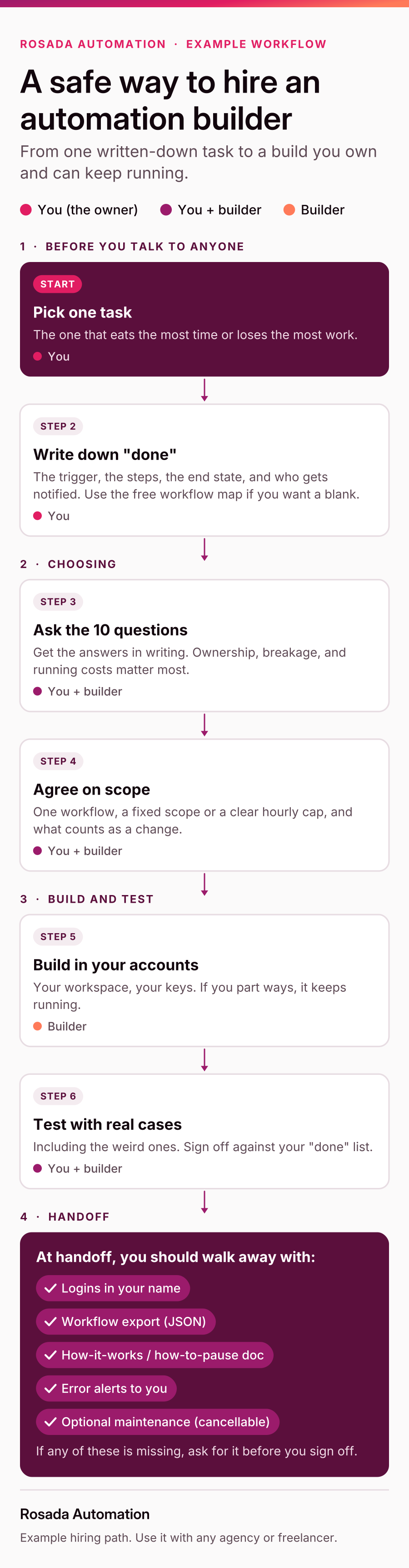
You can take the map to anyone. It's yours.
Freelancer or agency?
It depends on the scope.
Pick a freelancer if the build is small and well defined, and you want one person who knows the whole workflow.
Pick an agency if the work spans several systems, or you want backup when someone is out.
Either way, the ten questions apply. Your accounts, testing, and a real handoff matter more than the label.
How I answer these
Every build is scoped, built, and handed off by me. No account managers, and no retainer you can't cancel. A scoped, fixed-price build on tools you already use. No hourly billing. You own it. Builds run on your existing stack wherever possible; if a new tool is required, you'll know the cost up front. Access control and an audit trail are part of the build. Timing depends on scope.
Examples: what to text when you miss a call, after-hours calls for HVAC and plumbing.
Is an AI automation agency worth it?
It can be, if you're hiring someone to fix one clear process, not to "add AI."
Worth it when: one repetitive task, clear end state, built in your accounts, tested on real cases.
Not worth it when: the pitch starts with tools, it runs only in their account, or nobody can say what breaks.
Start with a map
FAQ
Is an AI automation agency worth it for a small business?
It can be, if the work is scoped to one clear workflow, built in your accounts, and handed off properly. The value comes from the process it fixes, not the word "AI." Start with one task, and ask the ten questions before you sign.
Should I hire a freelancer or an agency for automation?
Either can work. Freelancers often suit small, well-defined builds. Agencies may offer more coverage and backup. What matters more is a written scope, building in your accounts, testing, and a real handoff.
Who owns the automation after the builder leaves?
Whoever owns the accounts it runs in. Make sure it's built in your own automation workspace with your logins and keys, and that you get an export and a short how-it-works document at handoff.
What should I ask about AI specifically?
Ask where the AI is in the workflow, what it decides, what happens when it's wrong, and whether a regular automation could do the job. Plenty of useful automations don't need AI at all.
What ongoing costs should I expect after an automation is built?
Usually some combination of the automation platform's subscription, usage fees for things like texting or AI, and optional maintenance. Ask for a written monthly estimate and whether maintenance can be cancelled.
What are red flags when hiring an automation consultant?
No written scope, the automation running only in their account, no plan for when it breaks, results promised before they've seen your process, and AI they can't explain in one sentence. A good builder answers all of these plainly.
Sources
- FTC, "FTC Announces Crackdown on Deceptive AI Claims and Schemes" (Operation AI Comply), September 25, 2024: https://www.ftc.gov/news-events/news/press-releases/2024/09/ftc-announces-crackdown-deceptive-ai-claims-schemes
- FTC, "Start with Security: A Guide for Business," August 2023: https://www.ftc.gov/business-guidance/resources/start-security-guide-business
- n8n Docs, "Export and import": https://docs.n8n.io/workflows/export-import/
- Rosada Automation home page (demo labeling and how builds work): https://rosadaautomation.com/
Casia